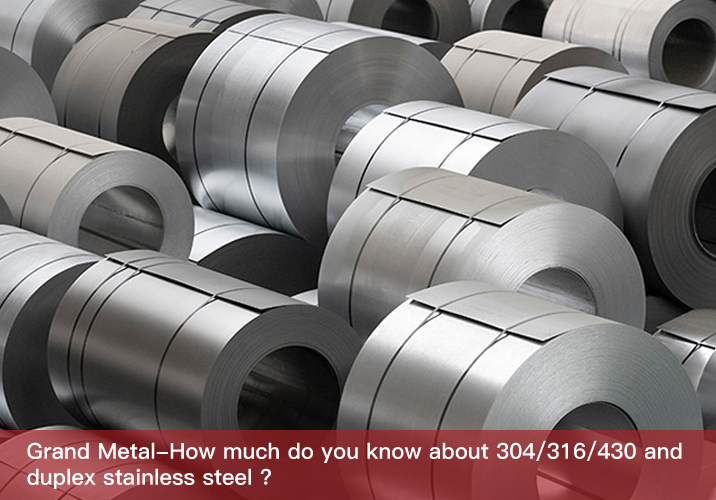
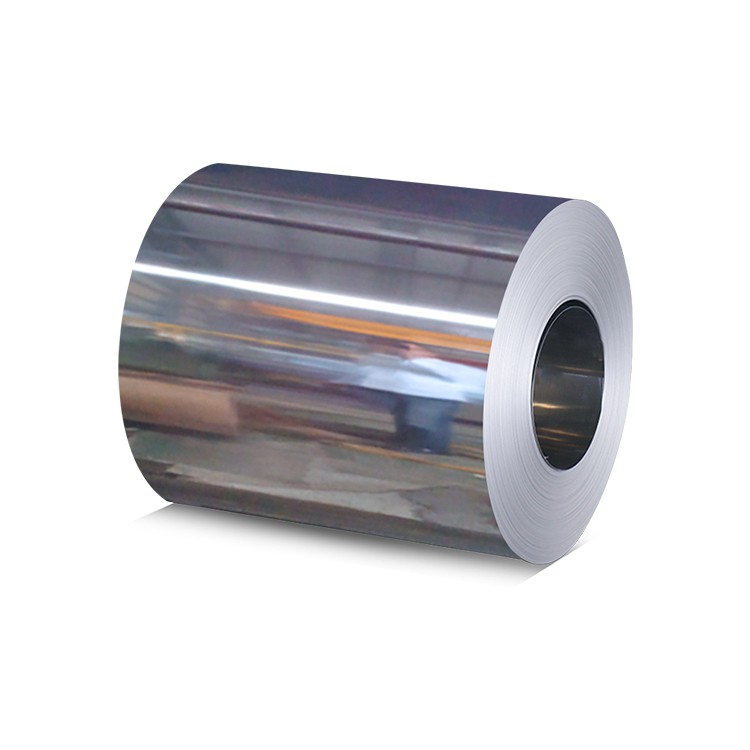
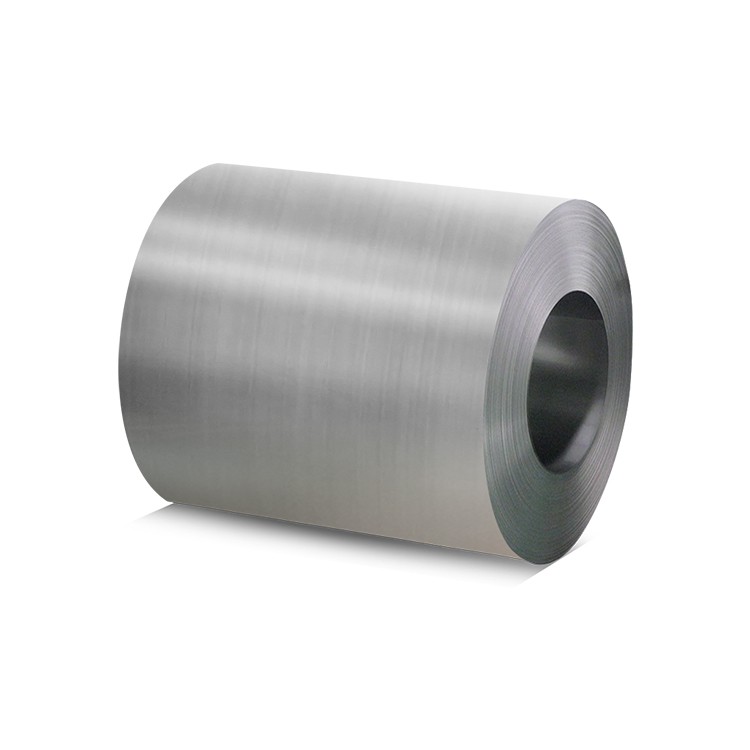
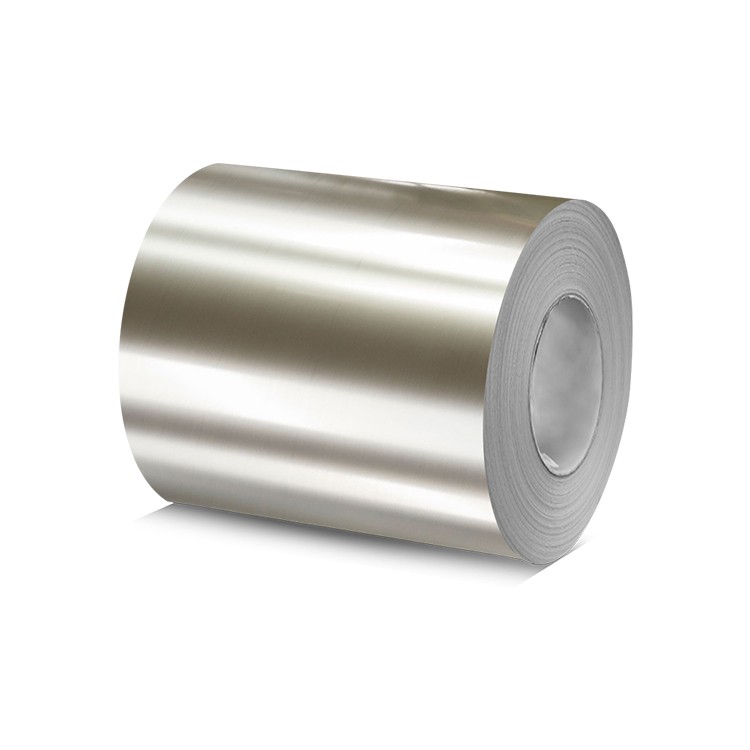
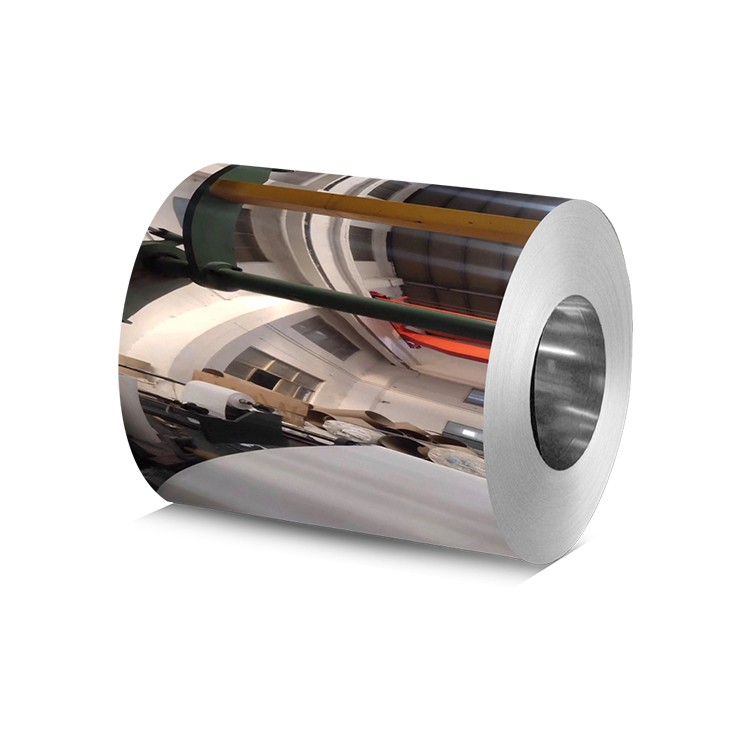
Most people treat "inox"and "stainless steel" as the same word — correctly, as it happens. The trouble starts one step later, when the same word is used to order several tonnes of metal. In the following, Grand Metal will explain the origin of this term, the actual performance characteristics associated with different grades, and six common misconceptions that could lead to financial losses for buyers.

QUICK ANSWER
Inox is stainless steel. The word is a contraction of the French acier inoxydable — literally "non-oxidising steel" — and it is the standard term in France, Italy, Spain, Portugal, Belgium and across much of international trade. There is no metallurgical difference between "inox" and "stainless steel". But inox names a material family, not a grade: an order that says only "inox" tells a mill nothing it can roll.

1.One word, two markets
2.Inox vs stainless steel: is there a difference?
3.Five families, one trade name
4.Six things most people get wrong
5.Finishes change the price more than the grade
6.Frequently asked questions
7.Conclusion
The word arrived before the metal had a settled English name. French metallurgists, following Léon Guillet's work on iron–chromium alloys from 1904, described the new compositions as acier inoxydable — steel that does not oxidise. French industry shortened it to inox almost immediately, the way English shortened "refrigerator" to "fridge". From there it travelled into Italian, Spanish, Portuguese and Dutch trade papers, and stayed.
English went a different way. When Harry Brearley cast his 12.8% chromium, 0.24% carbon heat at the Brown-Firth laboratory in Sheffield on 20 August 1913, he first called it rustless steel. It was a local cutler, Ernest Stuart, who pointed out that the metal did not stain either, and "stainless" stuck. Two words, one invention, and a century of mild confusion between the two.
The detail worth remembering is what happened in between. In 1908 and again in 1911, the German metallurgist Philip Monnartz published the observation that set the whole industry in motion: once chromium passes roughly 12%, the alloy stops behaving like steel and starts behaving like a ceramic shield. He called the effect passivation. That single threshold explains why inox resists corrosion, why 10.5% chromium is the legal floor for calling something stainless, and why a scratch on a kitchen sink is not the disaster it looks like.
WHY THIS MATTERS COMMERCIALLY
In most of Europe and much of Asia and the Middle East, "inox" is not a brand, a finish or a quality tier — it is simply the material category. That is exactly why it appears on purchase orders next to a number, as in "inox 304", "inox 1.4301", or the ambiguous "inox 18/8". Without the number, the word is a description. With the number, it is a specification.

Metallurgically, none. Chemically, none. Legally, none. In every standard that matters — EN 10088 in Europe, ASTM A240 in the United States, JIS G4304 in Japan, GB/T 3280 in China — the thing being specified is a steel with at least 10.5% chromium and at most 1.2% carbon. Whether the invoice calls it inox, stainless, Edelstahl or Rostfrei changes nothing about the metal in the crate.
What does change is what the word implies about precision. English-language technical writing tends to pair "stainless steel" with a grade designation out of habit. Transliterated trade documents often carry "inox" alone, because in the writer's market everyone knows which grade is meant — usually 304 for generic fabrication. That assumption is where projects go wrong.
| WHERE IT COMES FROM | WHAT IT SAYS | WHAT IT ACTUALLY SPECIFIES |
| French / Italian / Spanish trade | Inox, acciaio inox, acero inox | The alloy family — nothing more, unless a grade follows |
| US engineering practice | Stainless steel, 304 / 316L | AISI/SAE designation, widely understood, not a product standard |
| European standards | EN 10088, 1.4301 / 1.4404 | Exact chemistry, mechanical properties and delivery condition |
| Asian mill practice | SUS 304, 06Cr19Ni10 | JIS or GB grade, usually quoted alongside a mill certificate |
So the useful answer to "is inox different from stainless steel?" is: the words are interchangeable, the numbers are not. Two suppliers can both deliver "inox" and hand you alloys that behave completely differently in a coastal kitchen — one still bright after eight years, the other spotted within a season.

Under the single word "inox" sit five metallurgical families with genuinely different behaviour. The differences are set by crystal structure, which is set by nickel and carbon content. This is the layer of knowledge that separates someone who has read a datasheet from someone who has specified a job.
01.AUSTENITIC · 300 & 200 SERIES
Austenitic,Nickel-stabilised, face-centred cubic. The workhorse: best formability, weldability and general corrosion resistance. Non-magnetic when annealed.
02.FERRITIC · 400 SERIES
Ferritic,Chromium only, no nickel. Cheaper, magnetic, moderate corrosion resistance, poor weld toughness in thick sections. Excellent for dry interiors and appliances.
03.MARTENSITIC · 400 SERIES
Martensitic,Hardenable by heat treatment. Knife blades, valve trim, surgical instruments. Highest hardness, lowest corrosion resistance of the five.
04.MARTENSITIC · 400 SERIES
Martensitic,Hardenable by heat treatment. Knife blades, valve trim, surgical instruments. Highest hardness, lowest corrosion resistance of the five.
05.PRECIPITATION HARDENING
PH grades,Strength raised by aging rather than quenching. Aerospace fittings, shafts, high-pressure parts. Niche, expensive, specified by engineers rather than buyers.
Notice what the cards have in common: none of them are "better" than the others. A martensitic blade holds an edge that 316 cannot, and rusts where 316 would not. A duplex tube is twice as strong as 304 and costs nearly twice as much. Choosing is a matching exercise, not a ranking.

These are not trivia. Each one shows up as a specification error, a rejected delivery or a warranty claim.
01."If a magnet sticks, it isn't real inox.”
Reality: a magnet tells you the crystal structure, not the quality. Annealed 304 is essentially non-magnetic, but bend it, draw it or roll it and some of the austenite converts to martensite — the deformed corner of a 304 sink will often pull a magnet slightly. Meanwhile 430 is magnetic by design and perfectly fit for a dry interior panel. Use a magnet to guess the family. Use a mill certificate to know the grade.
02."Thicker sheet is always safer.”
Reality: thickness buys stiffness, not corrosion resistance. A 1.5 mm panel of 201 will pit long before a 0.8 mm panel of 316L in the same coastal air, because the attack is electrochemical and starts at the surface. Buyers who "upgrade" to thicker 304 to fix a rusting problem usually pay more and solve nothing.
03."18/10 is a higher grade than 18/8.”
Reality: both describe 304-family chemistry — 18% chromium with either 8% or 10% nickel. The 18/10 stamp is a cutlery marketing convention that generally means nickel was held near the top of the 8–10.5% range. It is a composition hint, not a grade, and it carries no standard behind it.
04."Surgical grade" or "food grade" means something specific.
Reality: neither is a standardised designation in EN or ASTM. "Surgical" usually points at 1.4021 or 1.4034 for instruments; "food grade"usually means 304 or 316L with a clean, passivated finish. If a supplier cannot give you a grade number and a certificate, the label is decoration. In the EU, food-contact compliance is about the finished article's nickel release and cleanliness, not the word on the brochure.
05."Inox is inox — 201 is basically the same as 304.”
Reality: this is the expensive one. Grade 201 replaces most of the nickel (8–10.5% in 304) with manganese and nitrogen, cutting cost by 30–50%. It is a legitimate alloy for dry decorative work and a bad one for wet kitchens — it pits, stains and cracks under deep drawing. If a quotation for “inox 304” lands well under the market, check the mill certificate for manganese and nickel before you cut anything. A drop of manganese detection liquid takes thirty seconds and settles the argument.
06."A welded joint is as corrosion-resistant as the parent metal.”
Reality: only after post-weld cleaning. Welding heats the steel into the 450–900 °C range, where chromium migrates to form carbides at the grain boundaries and leaves the adjacent zone chromium-depleted — sensitisation. That band cannot form a proper passive film, so it rusts first. Grinding the heat tint off is not enough: the tint is oxide, but the depletion is metallurgical. Pickle and passivate, or specify an L-grade and control heat input.

Buyers obsess over 304 versus 316 and then accept whatever finish the mill happens to have. That is backwards. Finish determines cleanability, how visible a scratch becomes, and often more of the price than the alloy does.
| FINISH | HOW IT IS MADE | RA (ΜM) | USE IT FOR | WATCH OUT |
| 2B | Cold rolled, annealed, pickled, skin-passed | 0.2–0.5 | Default for fabrication and food equipment | Not decorative; shows handling marks |
| BA | Bright annealed in a controlled atmosphere | 0.05–0.2 | Reflective, sanitary, appliance interiors | No pickling layer — surface contamination shows immediately |
| No. 4 | Ground with a 120–150 grit abrasive | 0.8–1.2 | Kitchen counters, architectural panels | Directional grain; scratches must follow it |
| Hairline (HL) | Long-grain polishing, often with a protective film | 0.4–0.8 | Lift cladding, appliance fronts, elevators | Film must be removed before welding, or it burns in |
| 8K mirror | Progressive polishing to a mirror | ≤0.05 | Feature walls, signage, luxury fit-outs | Shows every fingerprint and micro-scratch; consider an anti-fingerprint coating |
There is a corrosion consequence hidden in this table. Rougher surfaces hold water and chloride longer, and polishing debris can be embedded in the grain. Two identical 316L panels, one 2B and one mirror, will not perform identically on a seafront — the smoother one stays clean longer, which is why marine work often specifies a fine brushed or polished finish for reasons that have nothing to do with appearance.

01.Is inox the same as stainless steel?
Answer:Yes."Inox"is short for the French acier inoxydable and is the everyday term in France, Italy, Spain, Portugal, Belgium and much of international trade. There is no metallurgical difference. The practical difference is that inox names a category rather than a grade, so it should always be followed by a number — 1.4301, 304, 1.4404.
02.Is inox magnetic?
Answer:It depends on the family. Austenitic grades such as 1.4301 are non-magnetic when annealed but become slightly magnetic after cold working. Ferritic and martensitic grades are magnetic by design. A magnet is a rough family indicator and a poor grade test.
03.Does inox rust?
Answer:It can. The alloy protects itself with a chromium-oxide film of roughly 1–3 nanometres that regrows in the presence of oxygen. Chlorides break that film locally and cause pitting; stagnant liquid in crevices prevents it from rebuilding; welding heat depletes chromium in the heat-affected zone. Surface contamination with free iron produces rust spots on material that was never defective.
04.What is the difference between 304 and 316 inox?
Answer:1.4404 (316L) adds 2–3% molybdenum and caps carbon at 0.03%, against 1.4301 (304) which has no molybdenum and allows 0.08%. The molybdenum raises resistance to chloride pitting and crevice corrosion, which is why coastal, marine and chemical work specifies 316L. Expect to pay roughly 1.4–1.6 times the 304 price.
05.Can inox be repaired if it starts to rust?
Answer:Usually, yes — if the attack is superficial. Grind out the pit, clean to bare metal with dedicated stainless tooling, then pickle and passivate to restore the chromium-oxide film. If pitting has penetrated the wall or the part is in a cyclic-load application, replace it: a pit is a stress raiser, and the alloy has already told you it is the wrong choice for that environment.

Inox is one of the most successful materials ever made, and most of the confusion around it is linguistic rather than technical. The word came from French, the metallurgy came from Sheffield and Krupp, and the commercial trouble comes from using a category name where a grade number belongs.
Inox = stainless steel. Same metal, different language. Always attach the grade.
Corrosion resistance is a film, not a bulk property. Protect the film — oxygen, cleanliness, no chlorides, no crevices — and any inox lasts.
Grade before thickness. Upgrading 304 to 316L fixes coastal rusting; adding 0.5 mm does not.
Welds are the weak point until they are pickled and passivated. Budget for it.
Check the certificate, not the label. Thirty seconds with a mill certificate prevents the 201 substitution problem entirely.

By continuing to use the site you agree to our privacy policy Terms and Conditions.